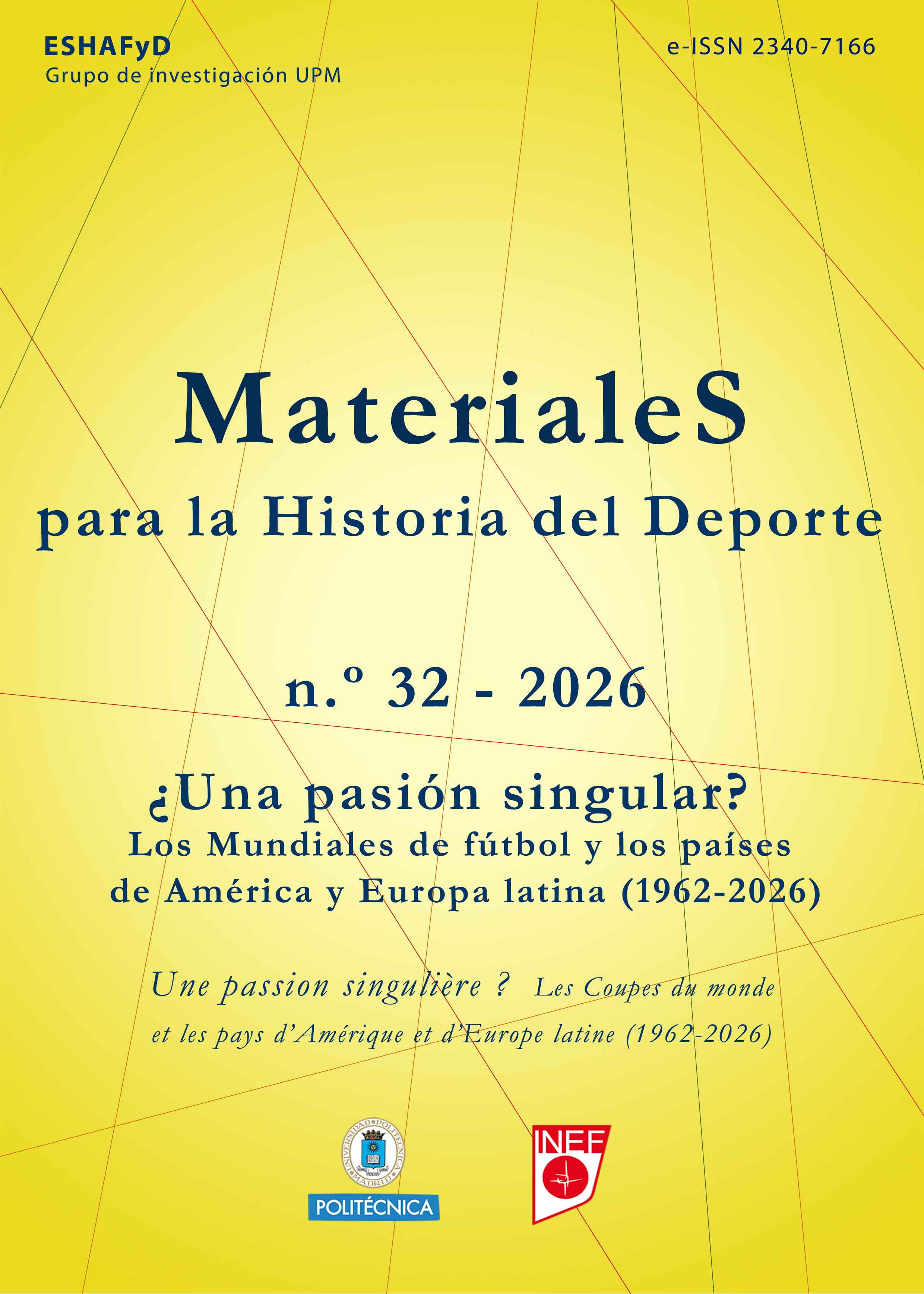
A singular passion? The World Cups and the countries of Latin America and Europe (1962-2026)
DOI:
https://doi.org/10.20868/mhd.2026.32.5683Abstract
On the occasion of the upcoming 2026 FIFA World Cup, organized for the first time by three countries (the United States, Canada, and Mexico), the editorial board of Materiales para la Historia del Deporte has devoted a special issue to this competition examined through the prism of Latinity. The historiography of the World Cup in football history is extensive, as illustrated by the works of Dietschy, Gastaut, and Mourlane (2006), Wahl (2013), Rinke and Schiller (2014), Brizzi and Sbetti (2018), and González-Aja (2023), as well as the special issues published by ISTOR (2018), Soccer & Society (2020 and 2022), and Football(s). Histoire, culture, économie, société (2022). Nevertheless, the historical object constituted by the FIFA World Cup remains far from exhausted.
Downloads
Riferimenti bibliografici
Brizzi, Riccardo et Nicola Sbetti. 2018. Storia della Coppa del mondo di calcio (1930–2018). Politica, sport, globalizzazione. Le Monnier.
Broudehoux, Anne-Marie. 2017. Mega-Events and Urban Image Construction: Beijing and Rio de Janeiro. Routledge.
Caminero-Santangelo, Marta. 2025. « Latinidad, again ». Latino Studies 23 : 1–3. https://doi.org/10.1057/ s41276-025-00511-8.
Correia, Miguel. 2019. Una historia popular del fútbol. Hoja de Lata.
Desjardins, Benjamin M. 2021. « Mobilising gender equality : A discourse analysis of bids to host the FIFA Women’s World Cup 2023 ». International Review for the Sociology of Sport 56 (8) : 1189–205. https:// doi.org/10.1177/1012690221998131.
Dicenta, José Luis. 2011. « ¿Cómo definir la latinidad a inicios del siglo XXI? ». Cuadernos Americanos 135 (1) : 189–93.
Dietschy, Paul. 2010. Histoire du football. Perrin.
Dietschy, Paul. 2022. « La Coupe du monde dans toutes ses dimensions ». Football(s). Histoire, culture, économie, société (1).
Dietschy, Paul, Yvan Gastaut et Stéphane Mourlane. 2006. Histoire politique des Coupes du monde. Vuibert.
González Aja, Teresa. 2023. Historia del fútbol. De juego simple a espectáculo complejo. Catarata.
Mason, Tony. 1995. Passion of the People? Football in Latin America. Verso.
Rinke, Stefan et Kay Schiller. 2014. The FIFA World Cup 1930–2010: Politics, Commerce, Spectacle and Identities. Wallstein Verlag.
Segura M. Trejo, Fernando. 2018. « Historia de los mundiales ». ISTOR. Revista de Historia Internacional 18 (72).
Vonnard, Philippe, Clément Astruc, Lorenzo Jalabert D’Amado et Nicola Sbetti. 2020. « Organizing the World Cup: Organization, Heritage and Failing Bids ». Soccer & Society 21 (8).
Waele, Jean-Michel de et Robert Adam. 2022. « The Many Worlds of the World Cup: National Experiences of a Global Event ». Soccer & Society 23 (7).
Wahl, Alfred. 2013. Histoire de la Coupe du monde de football. Peter Lang.
Dowloads
Pubblicato
Versioni
- 2026-07-17 (2)
- 2026-07-15 (1)
Fascicolo
Sezione
Licenza
Copyright (c) 2026 Paul Dietschy, Noemi García Arjona (Autor/a)

Questo volume è pubblicato con la licenza Creative Commons Attribuzione - Non commerciale - Condividi allo stesso modo 4.0 Internazionale.
Aquellos autores/as que tengan publicaciones con esta revista, aceptan los términos siguientes:- Los autores/as conservarán sus derechos de autor y garantizarán a la revista el derecho de primera publicación de su obra, el cuál estará simultáneamente sujeto a la Licencia de reconocimiento de Creative Commons que permite a terceros compartir la obra siempre que se indique su autor y su primera publicación esta revista.
- Los autores/as podrán adoptar otros acuerdos de licencia no exclusiva de distribución de la versión de la obra publicada (p. ej.: depositarla en un archivo telemático institucional o publicarla en un volumen monográfico) siempre que se indique la publicación inicial en esta revista.
- Se permite y recomienda a los autores/as difundir su obra a través de Internet (p. ej.: en archivos telemáticos institucionales o en su página web) antes y durante el proceso de envío, lo cual puede producir intercambios interesantes y aumentar las citas de la obra publicada. (Véase El efecto del acceso abierto).